Many people who visit the Galapagos have a fascination with Darwin, or Evolution, or Biology etc. And while there, Im sure that most people spend at least a little while thinking about the associated ideas in their own way... Im no different :)
And here is what I was thinking:
Apparently, about 70% of the plants and animals on the Galapagos are endemic... which means that they occur nowhere else but there... Amazingly high proportion of endemisme!
So, all those plants and animals must have arrived on the islands as castaways and as representatives of species from other places. Now, those parent populations are generally quite stable in their genetics (which is why they are species in the first place) Its the genetic diversity in the large parent populations that stabilise the species (rather than it being just a bunch of mutants!). So, it seems that a large population with the normal cross-breeding of "random mating pairs" seems to reduce the mutation rate... Im speculating a bit there but I think Im right.
In effect, any random genetic mutation that does occur is quite likely to disappear in the next generation or two as the interbreeding "dilutes" the mutative gene... That is unless there is strong selective pressure from the environment... in which case the "effective" breeding population is in fact the small number of mutant members who produce viable offspring (The others fail and are "selected out" !)
Alternatively, if the selective pressures are much more mild, it is still possible for species divergence if there is a "sexual selection" process acting at the same time and in the same direction... Which is to say that if the small group of individuals (with the mutation in question) in the larger population also "choose" to prefer to mate with each other rather than the "random" pairings of the larger group...
But, the combination of a "beneficial physical mutation (or at least not detrimental)" AND a "preferential mate selection mutation" is FAR less likely to occur than the single mutation... Hence the larger populations are quite stable.
So, the corollary to the large populations being stable and effectively discouraging speciation is that the smaller populations are less stable and encourage speciation.
But what I refer to as speciation is really just random mutations combined with selective environments... And, true enough, we are constantly reminded of the risks of too small a group of breeding individuals resulting in "in-breeding" and genetically inferior/weak off-spring. It happens quite a lot in specialised breeds of cats and dogs etc, and environmentalists are always very concerned about maximising the genetic variety in breeding programs for endangered species like Pandas and Cheetahs and Snow Leopards etc...
But, thats kind of my point, EVERY species MUST have originated from just a few individuals with a particular genetic mutation and from there they became numerous and stabilised into a species.
I think the issue is that if you want to "keep things from changing" then you want a large group and lots of cross breeding... But, if you want to encourage adaptation, then in fact you WANT a SMALL group with INBREEDING as well as strong external selective pressure!
The down side of this is that the chances are that a great many of the "random" mutations that occur in the in-bred group will in fact be detrimental to the survival of the "afflicted" individual and will result in it and its offspring being "selected out"!
Hmmm
... And this all has consequences for Humans I think!!!
Particularly if we consider that the same evolutionary process that results in physical changes in a species is also effective in Behavioural changes in a species (sexual selection being but one example)... Thats definite for behaviours that are hereditary (like mating displays in birds for example) but I think it still has a strong influence over learned behaviours too...
Now, if we humans need to adapt to a changing environment then the chances of us achieving that with the extremely large population base we have are Very low.... But we do appear to be rapidly changing our environment (... And those external selective pressures are "building" as the planets ecosystems are changed by our undoubtedly destructive habits)
And the human population continues to rise and the planet continues to decline in its environmental health/stability...
Of course, its all well and good to say "Yes, but we are Intelligent beings and we can choose to change our behaviours at will, and we can use our intelligence to adapt the physical world to us rather than us having to adapt to the world... So, what your talking about is just bunk!"
But,in fact, I dont think thats quite true.... Yes, we have the potential to do it, but if you take a good hard look at what we actually do then you will see that we rarely make the "intelligent" or rational choices, and we almost always make the emotive and instinctive choices... Even when its obviously Not rational.... The reality is that much of our behaviour is operating "outside" of our intelligence.
Back to my original theme...
Now, Nature always provides solutions!... And if a large population will not adapt to changing environment, then it WILL be reduced in size either to extinction or to the point where the smaller surviving population DOES adapt!
And as much as we might like to think that we are "outside" of the rules of nature; Truth is that we are not, and that this rule applies just as much to us as any other life on earth.
And so now Ill go for some WILD speculation... Unsupported by any real hard evidence and the product of my own prejudices :)))
Im pretty sure that within my lifetime, there is going to be a massive humanitarian crisis as population grows and environmental degradation accelerates and the inevitable result that food supplies for people are insufficient!
I strongly suspect that the human population will continue behaving as it has done (ie badly as far as sustainability is concerned) and will continue to increase in numbers, right up until the point where the "Unsustainability" problem is "brought home" in that completely unavoidable way that nature has!, And then the population will be forcibly and severely reduced in size (probably starting in the economically poorest, and environmentally most compromised parts of the world and spreading from there)... either to extinction, or to a size where the remaining population modifies its behaviours to be "sustainable"!
And how long will it all take?
Well, as I said, I think it will be well under way within my life time...
But it could take years or decades or centuries... I just dont know... But, there is a significant possibility that it could happen VERY quickly... Like Lake Atitlan in Guatemala suddenly turning green after many years of apparent "tolerance of pollution".
A couple of little examples of this "large stable, non-adaptive population" overwhelming an included "small adaptive population" sort of thing:
Environmental example:
On the shores of lake Atitlan there is a little restaurant. And the owner is an expat and he is thoughtful... and he grows his own veggies organically, and he has composting toilets and he does recycling, and has a minimal power usage etc... And his little restaurant is popular and moderately profitable.
In short, he cares and is aware of his impact on the environment.... The desirable adaptation.
But, he lives in amongst many many other people who are not aware and dont care... The undesirable but stable population group.
And, despite the presence of the desirable adaptation, (and despite his example and encouragement to others) it is swamped by the stable population and the lake is turned green regardless of how "well behaved" this individual is... Too bad, so sad!
Business example:
I worked in high-tech back in the days of the "Tech Boom". And when the "boom" was happening, companies were "growing" at incredible rates (quadrupelingin size in a year or less) and engineers were being hired as fast as they could get them to support this growth.... But to get the engineers the companies needed to grow, the companies had to offer them huge salaries... and promote junior people to senior positions way before they had the skills etc... It was all way out of control, and you could see that these hiring and promotion behaviours were incredibly bad for the companies in the long run... Im sure the executives in at least some companies were well aware of the future consequences of what they were doing...
BUT, they effectively had NO CHOICE...They were carried along with the "market".
As public companies, if they did not "grow" at the rates expected, then the stock market funding would not be given to them (it would go to the companies that did deliver on the expectations instead) and the "sensible" companies with "logical" hiring and promotion practices and moderate growth rates would have no funding and would doom themselves to "extinction"... and that certainly happened.
So, even companies who could see the crash would come and the consequences of poor hiring and promotion practices had to do it anyway in order to survive for the moment...and they doomed them selves to having to deal with the very unpleasant consequences of the crash when it came...
The problem was of course that no-one could predict exactly when the "crash" phase would actually occur... so they couldnt make good use of the desirable adaptation...
But, then again, What the hell do I know???
This is all just speculation :)))
Friday, January 15, 2010
If the Moon had Trees
... or maybe Mars...
Thats more or less what most of the Galapagos islands look like!
For the most part they are some of the bleakest, harshest, most Arid, little god-forsaken chunks of land on the planet !
Its quite surreal walking around in the baking heat on little islands made of nothing but lava and covered with the deadest, driest looking, miserable little sticks and cactus that youve ever seen!


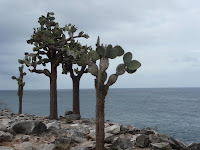
The plants are however, not dead at all, they are just dormant for the dry season... They are perfectly adapted to this incredibly harsh environment... just like the animals that we all know at least a little of.
Its what makes the Galapagos special... Their climate... Or more accurately; Their climates (plural).
The islands are the product of a volcanic hotspot located on the boundary of two separating tectonic plates. There are about a dozen decent sized islands ( and a few dozen more tiny ones and rocky outcrops) and they are all either directly created by volcanic eruptions or (for one or two) by tectonic uplift of lava flows that were below the ocean surface. Thats not so special in its self, but they are located hundreds of nautical miles from any other land; And they are also located at the confluence of four different Pacific ocean currents....
And thats what "does the trick" so to speak...
The combination of isolation, mixing warm and cold ocean currents (resulting in very rich marine life), equatorial location, volcanoes of different altitudes, and isolation from all other land has made them into "natures own environmental experimental pallet". The climate on each island, and on each part of the larger islands is different... But its not just "different", Its different, AND incredibly Harsh ... But not so harsh that Nature abandons it all together !
Given time Nature finds a way... And the ways are beautiful and unexpected :)) ... And if we havent come to expect just that kind of outcome from Nature yet, then we just have not been paying attention! :))))
And, the isolation too, is not complete, its only "almost". And over the millennia, the odd "castaway" plant or animal has made landfall on these barren little islands and has found a foothold. And undoubtedly, most of them died pretty quickly and unpleasantly... But, occasionally something managed to survive, and even reproduce... And most importantly (as far as evolution is concerned) to ADAPT and pass those adaptations on to their offspring...
And thats what makes the Galapagos special as far as we humans are concerned... They inspired Charles Darwin to put forward his theory of Evolution.. And that has changed the way we humans see everything.
Ive read a bit (in the past, though not recently) about the studies done on the Galapagos plants and animals and a bit on Darwin too, but I never "studied" biological sciences after early secondary school, so there is without doubt lots that I dont know.
As I recall though, it was the multitude of adaptations of the beaks (I think there are about a dozen different species of them) of the little finches on the island that Darwin chose as a strong exemplar of his theory of evolution. So, while I was visiting the islands, I kept an eye out for these little birds, and sure enough, they were pretty much all over the place.. Little black or grey/brown birds with beaks of different shapes and sizes. And they flitted around here and there, and if you look you see them.
But, you know what, Its far from obvious that these little birds are so different from island to island or a bit surprising to the casual observer that they, above all the other creatures and plants on the islands, were so significant...
What that highlights to me is the incredible scrutiny that Darwin applied to the world as he moved through it... He didnt just look at stuff; He LOOKED at it ... ALL of it... And he thought HARD about it ALL!! ... The power of observation and critical thought... Truly Brilliant!
If we all could but emulate this...
And sure enough, biological scientists are still happily studying the life of the Galapagos islands to this day... And they are learning more about how evolution really does work on a year by year basis here, as the micro-climates of the islands changes with El Nino and global warming, and the plants and animals continue to adapt.. and species start to emerge while others seem to combine and dissolve.
Quite literally, the iguanas and boobies are apparently producing new varieties that are diverging year by year from their forebears.
And as the plants on an island adapt to changing climates and their seed sizes change (no longer diverging into two different sizes), so too, the finches of that island that were diverging into two different beaks for the different seeds are now reverting back to the single variety that lived on the island before them.
Its all very dynamic... and perfectly balanced... The way Nature always does it :)))
Thats more or less what most of the Galapagos islands look like!
For the most part they are some of the bleakest, harshest, most Arid, little god-forsaken chunks of land on the planet !
Its quite surreal walking around in the baking heat on little islands made of nothing but lava and covered with the deadest, driest looking, miserable little sticks and cactus that youve ever seen!


The plants are however, not dead at all, they are just dormant for the dry season... They are perfectly adapted to this incredibly harsh environment... just like the animals that we all know at least a little of.
Its what makes the Galapagos special... Their climate... Or more accurately; Their climates (plural).
The islands are the product of a volcanic hotspot located on the boundary of two separating tectonic plates. There are about a dozen decent sized islands ( and a few dozen more tiny ones and rocky outcrops) and they are all either directly created by volcanic eruptions or (for one or two) by tectonic uplift of lava flows that were below the ocean surface. Thats not so special in its self, but they are located hundreds of nautical miles from any other land; And they are also located at the confluence of four different Pacific ocean currents....
And thats what "does the trick" so to speak...
The combination of isolation, mixing warm and cold ocean currents (resulting in very rich marine life), equatorial location, volcanoes of different altitudes, and isolation from all other land has made them into "natures own environmental experimental pallet". The climate on each island, and on each part of the larger islands is different... But its not just "different", Its different, AND incredibly Harsh ... But not so harsh that Nature abandons it all together !
Given time Nature finds a way... And the ways are beautiful and unexpected :)) ... And if we havent come to expect just that kind of outcome from Nature yet, then we just have not been paying attention! :))))
And, the isolation too, is not complete, its only "almost". And over the millennia, the odd "castaway" plant or animal has made landfall on these barren little islands and has found a foothold. And undoubtedly, most of them died pretty quickly and unpleasantly... But, occasionally something managed to survive, and even reproduce... And most importantly (as far as evolution is concerned) to ADAPT and pass those adaptations on to their offspring...
And thats what makes the Galapagos special as far as we humans are concerned... They inspired Charles Darwin to put forward his theory of Evolution.. And that has changed the way we humans see everything.
Ive read a bit (in the past, though not recently) about the studies done on the Galapagos plants and animals and a bit on Darwin too, but I never "studied" biological sciences after early secondary school, so there is without doubt lots that I dont know.
As I recall though, it was the multitude of adaptations of the beaks (I think there are about a dozen different species of them) of the little finches on the island that Darwin chose as a strong exemplar of his theory of evolution. So, while I was visiting the islands, I kept an eye out for these little birds, and sure enough, they were pretty much all over the place.. Little black or grey/brown birds with beaks of different shapes and sizes. And they flitted around here and there, and if you look you see them.
But, you know what, Its far from obvious that these little birds are so different from island to island or a bit surprising to the casual observer that they, above all the other creatures and plants on the islands, were so significant...
What that highlights to me is the incredible scrutiny that Darwin applied to the world as he moved through it... He didnt just look at stuff; He LOOKED at it ... ALL of it... And he thought HARD about it ALL!! ... The power of observation and critical thought... Truly Brilliant!
If we all could but emulate this...
And sure enough, biological scientists are still happily studying the life of the Galapagos islands to this day... And they are learning more about how evolution really does work on a year by year basis here, as the micro-climates of the islands changes with El Nino and global warming, and the plants and animals continue to adapt.. and species start to emerge while others seem to combine and dissolve.
Quite literally, the iguanas and boobies are apparently producing new varieties that are diverging year by year from their forebears.
And as the plants on an island adapt to changing climates and their seed sizes change (no longer diverging into two different sizes), so too, the finches of that island that were diverging into two different beaks for the different seeds are now reverting back to the single variety that lived on the island before them.
Its all very dynamic... and perfectly balanced... The way Nature always does it :)))


Tuesday, January 5, 2010
Feel The Burn!
Im becoming a "master" at the modern "fiscal art" of "credit based impulse buying" :))
Ive just committed about $2000 to a eight day trip to the Galapagos Islands!
I dont have this money, Its coming directly from credit...
And Ive been living directly off that credit supply for about a year now... Im building quite the little "mountain" of personal debt!
I currently have a large mortgage, am randomly spending thousands of dollars, have no income and am months away from even starting to look for a job (which by the way may well not be easy to get given my age/profession etc!)
But why stop when your just getting good at something :)
Actually, there is at least a bit of logic in it... Albeit selfish, consumer-minded, instant-gratification based logic! ... Yes, Im fully aware of what Im doing :))) .
...
The price is not bad relative to the going rates (last minute vacancy at a reduced rate).
The season is right,
The prices in the future will only ever get higher,
The condition of the islands is only ever likely to degrade (climate change and tourist pressure, and ocean health due to pollution etc),
Im not corrupting cultures or degrading the environment... its well and truly already commercialised.
And Im here in Ecuador now... If I wanted to go some other time, Id have to fork over lots more money for a flight to get to here and back as well as the trip to the islands etc.
And other than that, I would of course like to go and see the place... Having always been a big admirer of the natural environment and biodiversity etc :)
So, as of tomorrow night I will be "off air" for a bit over a week while I check out the Blue Footed Boobies, and Giant Tortoises, and Iguanas... and the "beaks of the finches" etc.
Ahhh, feel that financial burn! :))
Ive just committed about $2000 to a eight day trip to the Galapagos Islands!
I dont have this money, Its coming directly from credit...
And Ive been living directly off that credit supply for about a year now... Im building quite the little "mountain" of personal debt!
I currently have a large mortgage, am randomly spending thousands of dollars, have no income and am months away from even starting to look for a job (which by the way may well not be easy to get given my age/profession etc!)
But why stop when your just getting good at something :)
Actually, there is at least a bit of logic in it... Albeit selfish, consumer-minded, instant-gratification based logic! ... Yes, Im fully aware of what Im doing :))) .
...
The price is not bad relative to the going rates (last minute vacancy at a reduced rate).
The tour has a very good itinerary.
The boat is a good boat,The season is right,
The prices in the future will only ever get higher,
The condition of the islands is only ever likely to degrade (climate change and tourist pressure, and ocean health due to pollution etc),
Im not corrupting cultures or degrading the environment... its well and truly already commercialised.
And Im here in Ecuador now... If I wanted to go some other time, Id have to fork over lots more money for a flight to get to here and back as well as the trip to the islands etc.
And other than that, I would of course like to go and see the place... Having always been a big admirer of the natural environment and biodiversity etc :)
So, as of tomorrow night I will be "off air" for a bit over a week while I check out the Blue Footed Boobies, and Giant Tortoises, and Iguanas... and the "beaks of the finches" etc.
Ahhh, feel that financial burn! :))
Ch-ch-changes
My first travels of the world outside of my place of origin, in very small country towns in Western Australia, was way back in the late eighties. It was in fact when I got my very first job after graduating from Uni' as an engineer... The company I signed on with immediately stuck me on a plane and sent me to Argentina!...
I spoke note a word of Spanish, had no credit card, had about $100 in my wallet and had never been outside of Australia, never taken a taxi, never stayed in a hotel, ... and a bunch of other "never befores"....
And there was no one there at the other end of the flight to meet me! ...
When I did manage to get to the place I was meant to be in Buenos Aries, the people at the company office were "less than sympathetic"!
International phone calls were very expensive and I had no idea how to make one anyway and, well, ... I was EXTREMELY "Cut-off" and WAY outside my "comfort zone"
All in all, it was a bit of a "traumatic experience"!
Not surprisingly within a week I had decided that Id made a bad choice and I told the company Id had enough! ... And I flew back to Australia ... There to, lick my emotional wounds, and start a more or less normal graduate engineers working life :)
Really, the point of that little story is to set the stage on the things we humans need to feel "connected", and the rate of change in the way we are connecting.
We humans are social creatures... And its way more important than most of us ever recognise... Mostly because we are more or less all "Urban" and never get to be truly alone for more than a few hours. Even country people who live in small towns in remote places still live in "communities". The very few people who do spend lots of time alone end up being quite "Strange"... Like the sheep that lives away from the flock, the independent thinking creates a wholly "different animal"!... and in Humans, that "different animal" is usually different in ways that make them no longer "socially compatible"... and thats usually a bad thing!
That first travel experience of mine shows the core elements of what we need socially though:
We use other people as our reference points... We need the "emotional anchoring" of being able to communicate with other people so that we can feel "supported" and secure when the rest of our world changes and we are no longer in our comfort zone...
Over the millennia, we have evolved social systems to cope with "new situations" that are beyond the individuals or even the communities experiences...We fall back on the "wisdom of our elders" or we take a bit of a "group consensus" to gauge the group emotional response etc...
In strange and stressful circumstances we crave our "community" and we want to band together with a common front to face the problem...
All very evolutionarily sensible, and written very deeply in our emotional/psychological make-ups.
Back to my little story; Even in the modern world of just twenty five years ago, when I went travelling in a foreign language country, alone and without "resources", I was really "in the deep end". I had no "anchors", no "safe ground" or "reference points" other than my own previous experiences... Which clearly, and understandably, were not up to the task!
Since then, I have sporadically travelled to other countries over the years and things have steadily been getting easier. Certainly on the communications front... Calling people back home has been getting cheaper and cheaper over the years and while back then it was dollars per minute, it is now little more than a few cents a minute from/to anywhere in the world.
More recently, two years ago when I went on my first ride through Central America, I stayed at much the same sorts of places as I am staying this time. I met the same sorts of other travellers in about the same quantities. This time though I have noticed a big difference in the way We travellers are "communicating" with the rest of the world.
Two years ago, pretty much all the travellers were using the internet to stay in touch with family and friends on a regular (if not daily) basis. Likewise, most of them were also using Skype to have in-person conversations with their loved ones rather than the more expensive "phone booth" parlours that had prevailed before skype and the inter-net.
But all this was being done in "internet cafes" and the usual experience was that you had to put up with half a dozen people smoking cigarettes and having loud "skype" conversations within a few meters of you and your email/skype conversation . Note: There are lots of inter-net cafes in the developing countries now and fewer and fewer "phone booth" businesses ... for international phone calls.
This all makes a HUGE difference to the way travellers feel and behave! They have a good regular connection to that "social support network" and it makes them/us behave in a much more confident way. We get much "braver" as individuals, and that means that a much larger proportion of people are now willing to go travelling to "remote" and exotic places... In effect, those places become less remote and the travel becomes less daunting.
Two years ago, there were also some travellers though (maybe 10%), who were travelling with their own computer and were hooking up to Ethernet cables in the internet cafes or using WiFi in the same spaces.
But in the last two years that has changed again ... drastically!
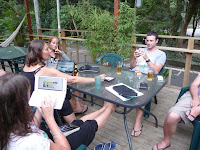
This time round, the advent of the "net-book" computer and the "iPhone" type devices, as well as "social networking" systems like "Twitter",and "FaceBook" has meant that about three quarters of travellers that I meet (myself included) are more or less Constantly "hooked in" to their social support networks.
And its now not in the internet cafes... Now its in a private or only partially public space in the comfort of the hostels where the travellers are staying... Like the phone parlours, the internet cafes days are definitely numbered!
And it means that anywhere with telephone connectivity (which is just about everywhere these days) is no longer "remote and scary"! Its all "fair game" for the modern "adventure traveller" who in the past would not have dared to step far outside of their own home towns!...
And this "Connected effect" is happening faster and faster. There is so much broadband connectivity these days that the developing countries are bypassing the whole "wired" stage and going straight to the"wireless and where ever" stage. The "antenna proliferation that supports this wireless connectivity that I am seeing is insane!


Its all very "consumer" and it has BIG consequences... The world is BEING changed by this "wave" of tourism by a new generation. Many of them are just young adults who are looking for something "exotic" to entertain them. Some of them are "eco-conscious" and try not to do too much damage to the world; But none of them are what I would call "socio-conscious" and are trying not to change the cultures of the places they visit! They all want to go to the "most remote and traditional villages" that they can get to... Preferably one that is not in any of the guide books yet... and that means that those places get changed by these visitors who all want their lattes and their hot showers and most of all, their internet access!
Now, Im travelling too, and Im changing the world too, and sure as eggs, even if I didnt travel other people would and the world would change anyway...
Actually, I can freely attest to the STRONGLY "addictive" nature of this "connectivity"... but as with anything addictive the effect is not all good...
But, I dont believe it can be stopped!... And Im not even going to start in on trying to decide if it "Should be" stopped or not (which is of course a moot point given that it clearly will go ahead as it currently is).
Im also sure that there are "unpleasant consequences" from it for the places/peoples being visited as well as the tourists themselves... But there are also good effects for both the visitors and the visited too...
Its a complex phenomenon and Ive made several posts on some of the issues in the past.
But what really gets me; and that I DO think is a very bad thing, is that no one seems to be at all aware of what they are doing or the effects they are having...
When I try to suggest to people what Im seeing, I usually fail completely, but on the few occasions when I do get my point across, the usual response is "Well, if I didnt do it someone else would, so Im gonna get my share"... And its true enough but its pretty much like a paedophile trying to justify child prostitution with the same argument!...
OK, maybe thats overstating it a bit, but just because other people do something that has a "dubious" impact on other peoples lives, doesnt mean that its OK for me to do it to....
All I really want is for people to "THINK about the consequences of what they are doing"...
... ahhh, but there I go; Dreaming again!
Ive written it down now and got it "off my chest", so now, I guess Ill just watch and wait and let what will be, be :)))
Interesting times we live in!
I spoke note a word of Spanish, had no credit card, had about $100 in my wallet and had never been outside of Australia, never taken a taxi, never stayed in a hotel, ... and a bunch of other "never befores"....
And there was no one there at the other end of the flight to meet me! ...
When I did manage to get to the place I was meant to be in Buenos Aries, the people at the company office were "less than sympathetic"!
International phone calls were very expensive and I had no idea how to make one anyway and, well, ... I was EXTREMELY "Cut-off" and WAY outside my "comfort zone"
All in all, it was a bit of a "traumatic experience"!
Not surprisingly within a week I had decided that Id made a bad choice and I told the company Id had enough! ... And I flew back to Australia ... There to, lick my emotional wounds, and start a more or less normal graduate engineers working life :)
Really, the point of that little story is to set the stage on the things we humans need to feel "connected", and the rate of change in the way we are connecting.
We humans are social creatures... And its way more important than most of us ever recognise... Mostly because we are more or less all "Urban" and never get to be truly alone for more than a few hours. Even country people who live in small towns in remote places still live in "communities". The very few people who do spend lots of time alone end up being quite "Strange"... Like the sheep that lives away from the flock, the independent thinking creates a wholly "different animal"!... and in Humans, that "different animal" is usually different in ways that make them no longer "socially compatible"... and thats usually a bad thing!
That first travel experience of mine shows the core elements of what we need socially though:
We use other people as our reference points... We need the "emotional anchoring" of being able to communicate with other people so that we can feel "supported" and secure when the rest of our world changes and we are no longer in our comfort zone...
Over the millennia, we have evolved social systems to cope with "new situations" that are beyond the individuals or even the communities experiences...We fall back on the "wisdom of our elders" or we take a bit of a "group consensus" to gauge the group emotional response etc...
In strange and stressful circumstances we crave our "community" and we want to band together with a common front to face the problem...
All very evolutionarily sensible, and written very deeply in our emotional/psychological make-ups.
Back to my little story; Even in the modern world of just twenty five years ago, when I went travelling in a foreign language country, alone and without "resources", I was really "in the deep end". I had no "anchors", no "safe ground" or "reference points" other than my own previous experiences... Which clearly, and understandably, were not up to the task!
Since then, I have sporadically travelled to other countries over the years and things have steadily been getting easier. Certainly on the communications front... Calling people back home has been getting cheaper and cheaper over the years and while back then it was dollars per minute, it is now little more than a few cents a minute from/to anywhere in the world.
More recently, two years ago when I went on my first ride through Central America, I stayed at much the same sorts of places as I am staying this time. I met the same sorts of other travellers in about the same quantities. This time though I have noticed a big difference in the way We travellers are "communicating" with the rest of the world.
Two years ago, pretty much all the travellers were using the internet to stay in touch with family and friends on a regular (if not daily) basis. Likewise, most of them were also using Skype to have in-person conversations with their loved ones rather than the more expensive "phone booth" parlours that had prevailed before skype and the inter-net.
But all this was being done in "internet cafes" and the usual experience was that you had to put up with half a dozen people smoking cigarettes and having loud "skype" conversations within a few meters of you and your email/skype conversation . Note: There are lots of inter-net cafes in the developing countries now and fewer and fewer "phone booth" businesses ... for international phone calls.
This all makes a HUGE difference to the way travellers feel and behave! They have a good regular connection to that "social support network" and it makes them/us behave in a much more confident way. We get much "braver" as individuals, and that means that a much larger proportion of people are now willing to go travelling to "remote" and exotic places... In effect, those places become less remote and the travel becomes less daunting.
Two years ago, there were also some travellers though (maybe 10%), who were travelling with their own computer and were hooking up to Ethernet cables in the internet cafes or using WiFi in the same spaces.
But in the last two years that has changed again ... drastically!
This time round, the advent of the "net-book" computer and the "iPhone" type devices, as well as "social networking" systems like "Twitter",and "FaceBook" has meant that about three quarters of travellers that I meet (myself included) are more or less Constantly "hooked in" to their social support networks.
And its now not in the internet cafes... Now its in a private or only partially public space in the comfort of the hostels where the travellers are staying... Like the phone parlours, the internet cafes days are definitely numbered!
And it means that anywhere with telephone connectivity (which is just about everywhere these days) is no longer "remote and scary"! Its all "fair game" for the modern "adventure traveller" who in the past would not have dared to step far outside of their own home towns!...

And this "Connected effect" is happening faster and faster. There is so much broadband connectivity these days that the developing countries are bypassing the whole "wired" stage and going straight to the"wireless and where ever" stage. The "antenna proliferation that supports this wireless connectivity that I am seeing is insane!


Its all very "consumer" and it has BIG consequences... The world is BEING changed by this "wave" of tourism by a new generation. Many of them are just young adults who are looking for something "exotic" to entertain them. Some of them are "eco-conscious" and try not to do too much damage to the world; But none of them are what I would call "socio-conscious" and are trying not to change the cultures of the places they visit! They all want to go to the "most remote and traditional villages" that they can get to... Preferably one that is not in any of the guide books yet... and that means that those places get changed by these visitors who all want their lattes and their hot showers and most of all, their internet access!
Now, Im travelling too, and Im changing the world too, and sure as eggs, even if I didnt travel other people would and the world would change anyway...
Actually, I can freely attest to the STRONGLY "addictive" nature of this "connectivity"... but as with anything addictive the effect is not all good...
But, I dont believe it can be stopped!... And Im not even going to start in on trying to decide if it "Should be" stopped or not (which is of course a moot point given that it clearly will go ahead as it currently is).
Im also sure that there are "unpleasant consequences" from it for the places/peoples being visited as well as the tourists themselves... But there are also good effects for both the visitors and the visited too...
Its a complex phenomenon and Ive made several posts on some of the issues in the past.
But what really gets me; and that I DO think is a very bad thing, is that no one seems to be at all aware of what they are doing or the effects they are having...
When I try to suggest to people what Im seeing, I usually fail completely, but on the few occasions when I do get my point across, the usual response is "Well, if I didnt do it someone else would, so Im gonna get my share"... And its true enough but its pretty much like a paedophile trying to justify child prostitution with the same argument!...
OK, maybe thats overstating it a bit, but just because other people do something that has a "dubious" impact on other peoples lives, doesnt mean that its OK for me to do it to....
All I really want is for people to "THINK about the consequences of what they are doing"...
... ahhh, but there I go; Dreaming again!
Ive written it down now and got it "off my chest", so now, I guess Ill just watch and wait and let what will be, be :)))
Interesting times we live in!
Sunday, January 3, 2010
A Lane of My Own
I rode into Quito today.
I took a slightly different road this time, but it still crossed over the equator again. I stopped and took a couple of photos of the GPS read out cos some people said they would have liked to see it on the blog last time... So, here it is :))


The highways here are very good... That is, they are great considering the amount of climbing and falling they do through these massive valleys. But they are usually only a single lane each way, and as I got near the city, the roads got clogged with traffic. This happened last time I was here too, and it made for some very "sporting" riding to get through. This time though, the traffic was more orderly I thought, and they all just lined up neatly and waited for the line to move ahead.... maybe because it was a Sunday??
There were however no motorbikes to be seen, and I figure if there were any that they did what I did...
I simply used the lovely wide, flat, and paved shoulder of the road as my very own lane :)))
Its not wide enough for a small car, so the other drivers cant use it the same way, but I must have covered about 20km this way and only had to avoid a couple of cars stopped on the side of the road... It was no problem at all, and I rode right past two or three police cars as well, and they didnt seem to mind at all :)))

My own lane here in Ecuador makes up for having to pay at the toll booths. It was free all through Colombia (they had a special little side lane with no toll just for motorbikes), but it costs about $0.20 each time here in Ecuador...
Ya win some, Ya lose some :)
I took a slightly different road this time, but it still crossed over the equator again. I stopped and took a couple of photos of the GPS read out cos some people said they would have liked to see it on the blog last time... So, here it is :))


The highways here are very good... That is, they are great considering the amount of climbing and falling they do through these massive valleys. But they are usually only a single lane each way, and as I got near the city, the roads got clogged with traffic. This happened last time I was here too, and it made for some very "sporting" riding to get through. This time though, the traffic was more orderly I thought, and they all just lined up neatly and waited for the line to move ahead.... maybe because it was a Sunday??
There were however no motorbikes to be seen, and I figure if there were any that they did what I did...
I simply used the lovely wide, flat, and paved shoulder of the road as my very own lane :)))
Its not wide enough for a small car, so the other drivers cant use it the same way, but I must have covered about 20km this way and only had to avoid a couple of cars stopped on the side of the road... It was no problem at all, and I rode right past two or three police cars as well, and they didnt seem to mind at all :)))

My own lane here in Ecuador makes up for having to pay at the toll booths. It was free all through Colombia (they had a special little side lane with no toll just for motorbikes), but it costs about $0.20 each time here in Ecuador...
Ya win some, Ya lose some :)
Such Relief!


When they built South America, they didnt skimp on the relief!
The scale of the country I have been riding through since I landed here is enormous!
Pretty much every day that I ride, I am climbing up and down the sides of valleys that are well over a Km deep. Its mostly beautiful green farm land with a patchwork of fields and little townships with red tile roofs nestled in amongst the fields... But to call it "rolling green" really does no justice to the scale of the place. I cant capture it on the camera but suffice it to say that "temperature control" is a major problem while riding... Im regularly gaining or losing 1500m in the space of twenty minutes or so, and that results in 15 or 20 degC or more change in temperature!


And thats just for Colombia and Ecuador... Things get even more interesting further South.
A couple of days ago, I rode down to the coast of Colombia from Cali. There was not much of tourist interest there but one of the fishing villages on stilts was interesting...


A day later, I left Cali and rode South to Pasto as I mentioned in the last post.
Its big country in the South of Colombia as you move into "volcano country". In fact, Pasto is perched on the flanks of a volcano that is nearly 4000m high... and just for interest, its still active... and to add to that, scientists apparently say its got the explosive potential of Mt St Helens... And the day after I left (yesterday), it decided to erupt, throwing fiery rocks into the night sky!
Its the first day of a week long festival in Pasto, so I guess it sets that off quite well, but I hope it doesnt get "out of hand" for the sake of my friends Nancy and Henry there :)

But I had moved on to Tulcan on the boarder with Ecuador... Where I got stuck for half a day and a night due to there being no power and customs not being able to process my bike documents! Oh well, what can you do?
But, now Im in the land of the real volcanoes.


Here in Ecuador they grow them real big... I climbed a couple of them way back in the day... Chimborazo at 6300m and Cotopaxi at 6000m. But the first one I can see now is Cayambe at 5800m with a beautiful white glacier covered summit on a blue sky day :)))
Friday, January 1, 2010
The Truth Will Out!
I think thats how Shakespeare worded it regarding the secrets that people keep.
In this case Im talking more about our own "truths" rather than secrets, but it seems that the combination of a "Blue Moon", a "New Year" and a few drinks will loosen the toungs of just about any traveller...
I spent pretty much the whole of new years night chatting with many of the people in the hostel... Till 4am in the morning! Im not sure why but I seemed to get "the whole thing" from just about everyone I sat next to.. Or maybe they sat next to me??
But I also seemed to do fairly well at focussing on listening rather than focusing on sharing as I usually do... and that means I do a fair bit of talking. But last night I did better and didnt feel like I needed to put my "truth" out there quite as much as usual, though of course I did share when it seemed warranted :)))
And, truth be told, it seems that most of the young travellers were just about as lost as I am in this life :)))
Maybe thats what lifes for ??
Who knows... But what I do know is that I am rather tired today! But I got up and rode South at about 8am anyway.
I rode to a town called Pasto which I thought was a nice little colonial town but turns out is quite a big city (ahhh that crappy memory of mine again... the nice town was Popoyan which I rode past and not through today).
And everything is shut here cos its the first of Jan... I found a cheap hotel or two but they had no parking and all the parking places were closed!
So then I went and found parking but its miles from any hotels!!!
So then I stopped and had a bit of food and then stood about on a corner till a passer by offered to take me in for the night... (A last dich strategy that worked this time!)

So now Im at some nice peoples house and they are letting me use internet and are generally making me feel right at home :)))))
In this case Im talking more about our own "truths" rather than secrets, but it seems that the combination of a "Blue Moon", a "New Year" and a few drinks will loosen the toungs of just about any traveller...
I spent pretty much the whole of new years night chatting with many of the people in the hostel... Till 4am in the morning! Im not sure why but I seemed to get "the whole thing" from just about everyone I sat next to.. Or maybe they sat next to me??
But I also seemed to do fairly well at focussing on listening rather than focusing on sharing as I usually do... and that means I do a fair bit of talking. But last night I did better and didnt feel like I needed to put my "truth" out there quite as much as usual, though of course I did share when it seemed warranted :)))
And, truth be told, it seems that most of the young travellers were just about as lost as I am in this life :)))
Maybe thats what lifes for ??
Who knows... But what I do know is that I am rather tired today! But I got up and rode South at about 8am anyway.
I rode to a town called Pasto which I thought was a nice little colonial town but turns out is quite a big city (ahhh that crappy memory of mine again... the nice town was Popoyan which I rode past and not through today).
And everything is shut here cos its the first of Jan... I found a cheap hotel or two but they had no parking and all the parking places were closed!
So then I went and found parking but its miles from any hotels!!!
So then I stopped and had a bit of food and then stood about on a corner till a passer by offered to take me in for the night... (A last dich strategy that worked this time!)

So now Im at some nice peoples house and they are letting me use internet and are generally making me feel right at home :)))))
Subscribe to:
Posts (Atom)